Industrial Shredder Technical Specification Guide
For businesses looking for an industrial shredder, selecting the right machine is not just a purchasing transaction, but a critical investment that determines the efficiency of the entire production line. At MT Makina, we have analyzed the most challenging aspects of technical specification preparation and shredder procurement processes. We have gathered all the technical details you need to consider when choosing the most suitable shredding machine for your waste management or recycling projects in this comprehensive guide.
What is an Industrial Shredder?
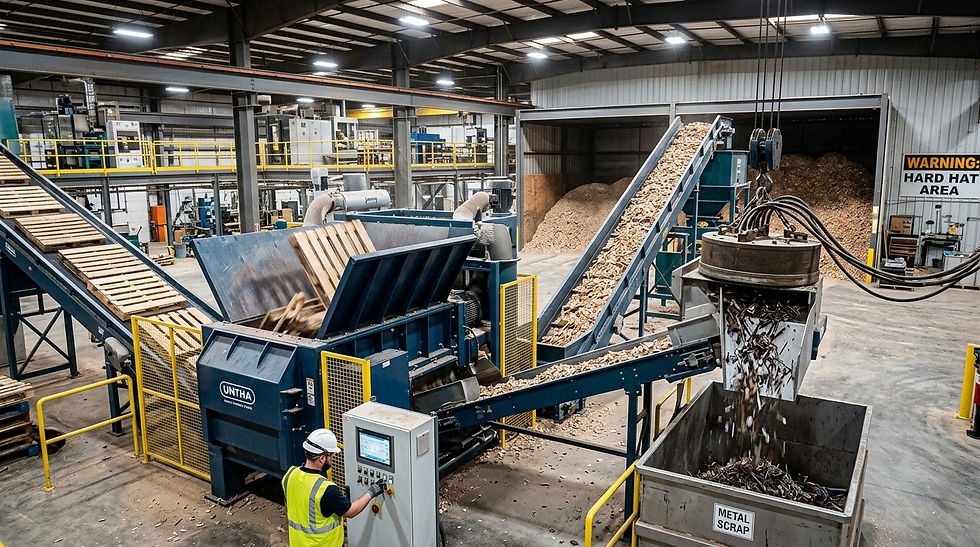
An industrial shredder is a powerful mechanical system designed to reduce voluminous and hard-to-process waste materials into smaller, manageable, and recyclable sizes. These machines can effectively shred a wide range of materials such as plastic, metal, wood, rubber, electronic waste, and biomass. The basic working principle relies on cutting blades on rotating shafts, driven by hydraulic or electric motors, which reduce the material by tearing, cutting, or crushing.
MT Makina's industrial shredding solutions operate on the principle of high torque and low speed, offering high efficiency even with tough materials. In modern industrial facilities, these machines are not just waste reduction tools; they are the first and most vital link in the raw material recovery chain. Uninterrupted and safe operation is ensured thanks to the machine's robust body structure, wear-resistant special alloy blades, and smart automation systems.
Material Analysis and Choosing the Right Machine
The most critical stage of the machine selection process is the detailed analysis of the physical and chemical properties of the material to be processed. The hardness, density, moisture content, size, and heterogeneous structure of the material to be shredded directly affect all features of the selected shredder, from motor power to blade profile. For example, flexible films and hard engineering plastics require entirely different cutting geometries and feed rates.
Therefore, before the shredder procurement process, the tensile strength and brittleness of the material must be tested. MT Makina experts conduct project-specific material analyses to determine the optimal blade angle, shaft speed, and torque requirement. Incorrect material analysis leads to frequent machine stoppages, early blunting of blades, and unnecessary increases in energy consumption, significantly raising operational costs.
Comparison of Single-Shaft and Double-Shaft Shredders
The choice between single-shaft and double-shaft machines depends entirely on the targeted output size and material type. Single-shaft shredders push the material toward the cutting diamond blades on the rotating rotor using a hydraulic pusher, ensuring a homogeneous and specific output size thanks to the screen underneath. Single-shaft systems offer ideal solutions especially for plastic lumps, pipes, paper bales, and materials requiring fine grinding.
On the other hand, double-shaft shredder systems stand out in pre-shredding operations with their high-torque and screenless structures. They are perfect for bulky, mixed municipal waste, tires, and industrial waste with a high probability of containing foreign objects. MT Makina's double-shaft shredding machine designs work on the principle of pulling the material in and tearing it, passing even the toughest blocks through the pre-sizing stage in seconds.
Feed System Selection and Integration
The efficiency of the shredding process is directly related to the proper design of the material feeding system into the machine. If the feed rate exceeds the machine's capacity, it causes blockages; if it falls below, it wastes energy. Different methods such as conveyor belts, bucket feeding, crane, or forklift dumping should be evaluated according to the facility's existing infrastructure and material type. Automatic feeding systems are particularly indispensable for a continuous and stable production line.
With smart feeding systems integrated with automation, MT Makina continuously measures the machine's motor load to optimize the feed rate. When the load increases, the feeder slows down or stops; when the rotor is relieved, feeding resumes. This fully integrated system not only extends the mechanical life of the machine but also guarantees continuous operation at maximum capacity without the need for operator intervention.
Capacity Calculation and Shift Planning
One of the most common mistakes businesses make when preparing technical specifications is capacity calculation. The statement "x tons per hour capacity" varies greatly depending on the material's type, density, and targeted output size. For an accurate capacity calculation, peak loading moments, the machine's idle times, and maintenance downtimes between shifts must definitely be taken into account. Choosing a 10-ton-per-hour machine for a daily goal of 50 tons means ignoring downtimes.
In addition to your business's current needs, future vision and capacity increase goals should also be considered. MT Makina works with its customers to run simulations suitable for real production conditions and offers motor-reducer combinations suitable for accurate shift planning. This way, both the return on investment (ROI) time is shortened, and capacity bottlenecks are prevented in advance.
Target Particle Size and Screen System
The size of the final product obtained in recycling processes directly determines the value of the material and the success of subsequent processing steps. The screen system used in single-shaft machines is the most reliable way to control the output size. Screen hole diameters are specially selected and manufactured from 10 mm to 100 mm according to the project's needs. However, it should not be forgotten that as the screen diameter decreases, the machine's capacity will decrease, and energy consumption will increase.
Having a quick-change design for the screen system provides operational flexibility for facilities that will process different materials. MT Makina's innovative body designs minimize downtimes by reducing screen change times to minutes. In double-shaft machines, screens are generally not used; the particle size varies according to the blade thickness and the number of hooks.
Output Fraction and Subsequent Processing Steps
Discharging the shredded material from the machine smoothly and transferring it to the next process step is an important part of system engineering. Discharge conveyors, augers, or pneumatic conveying systems should be selected according to the form and fluidity of the material. In addition, magnetic separators (overband magnets) must be integrated into the discharge line to separate unwanted metals (bolts, nails, etc.) that may be present in the shredded material.
MT Makina is not just a machine manufacturer, but also a technology partner that provides turnkey facility installations. Accordingly, we design discharge systems that are fully compatible with subsequent processes such as post-shredding washing, granulating, or optical sorting. The uninterrupted flow of material is one of the most fundamental elements that increase the overall equipment effectiveness (OEE) of the facility.
Safety Standards and Operator Training
Industrial shredding machines produce immense power, so it is vital not to compromise on occupational safety standards. Emergency stop buttons, switched safety doors, vibration, and temperature sensors must be integral parts of the machine. The machine being manufactured in full compliance with CE norms and complete risk analyses are among the essential conditions to look for during the purchasing stage.
In addition to physical safety measures, operators must receive detailed training about the machine. As MT Makina, we provide practical training to operators on maintenance, safe use, and troubleshooting after installation. A conscious operator maximizes the machine's performance while preventing potential occupational accidents and expensive malfunctions caused by misuse.
Maintenance Plan and Consumable Parts Management
Like every mechanical system, shredders also require regular maintenance. However, in a well-designed machine, access to maintenance points should be easy, and daily routine checks should not burden the operator. Blades, counter blades, rotor bearings, and screens are the most critical consumables. Especially the fact that the rotor blades are reversible (all 4 faces can be used by turning) directly reduces consumable parts costs by 75%.
Thanks to predictive maintenance technologies, the machine's hydraulic pressures, bearing temperatures, and motor currents are monitored in real-time. The remote access and IoT (Internet of Things)-based control systems offered by MT Makina detect potential malfunctions before they occur. With the right spare parts inventory and planned overhauls, the machine's uptime rate is always kept at the highest level.
Technical Specification Preparation Checklist
A solid technical specification is essential for a flawless procurement process. In this specification, not only superficial data such as motor power or weight but also details like shaft speed, rotor diameter, blade material hardness (HRC), body sheet thicknesses, and automation scenarios should be detailed. Also, the supplier's warranty conditions, on-site service time (SLA), and spare parts availability must be added to the specification as binding clauses.
Businesses should personally see at the factory that the machine provides the promised capacity and dimensions with factory acceptance tests (FAT) included in the specification. In accordance with the principle of transparency, MT Makina involves its customers in every stage of the production process and performs performance verification by making test cuts. A comprehensive technical specification is the most reliable ground for consensus protecting both parties.
Quote Evaluation and Comparison Criteria
When evaluating quotes from different suppliers, focusing solely on the initial investment cost (Capex) is a common mistake. The primary metric to consider should be the Total Cost of Ownership (TCO). When the machine's energy consumption, maintenance expenses, spare part life, and service costs are calculated from a 5-year perspective, it becomes clear that a machine that seems cheap can actually be the most expensive option.
During the evaluation process, the weight of the machine and material quality are important indicators; a heavy machine generally means thicker chassis, larger bearings, and a more durable rotor. With its heavy-duty designs and highly energy-efficient motor technologies compared to its competitors, MT Makina offers your business high profitability in the long run.
Conclusion
When done correctly, investing in an industrial shredding machine is a strategic move that dramatically increases your facility's waste management capacity and recycling revenues. Material analysis, appropriate technology selection, integrated system design, and accurate capacity planning are the cornerstones of this process. With a professional technical specification covering all these technical details, you can minimize risks and get maximum efficiency from your investment.
With its deep-rooted experience and engineering infrastructure in the sector, MT Makina produces tailor-made solutions specific to your project rather than selling standard products. For all the technical support, discovery, and consultancy services you will need during your shredder procurement process, you can contact our expert engineering team and meet the right technology that will add value to your facility.